
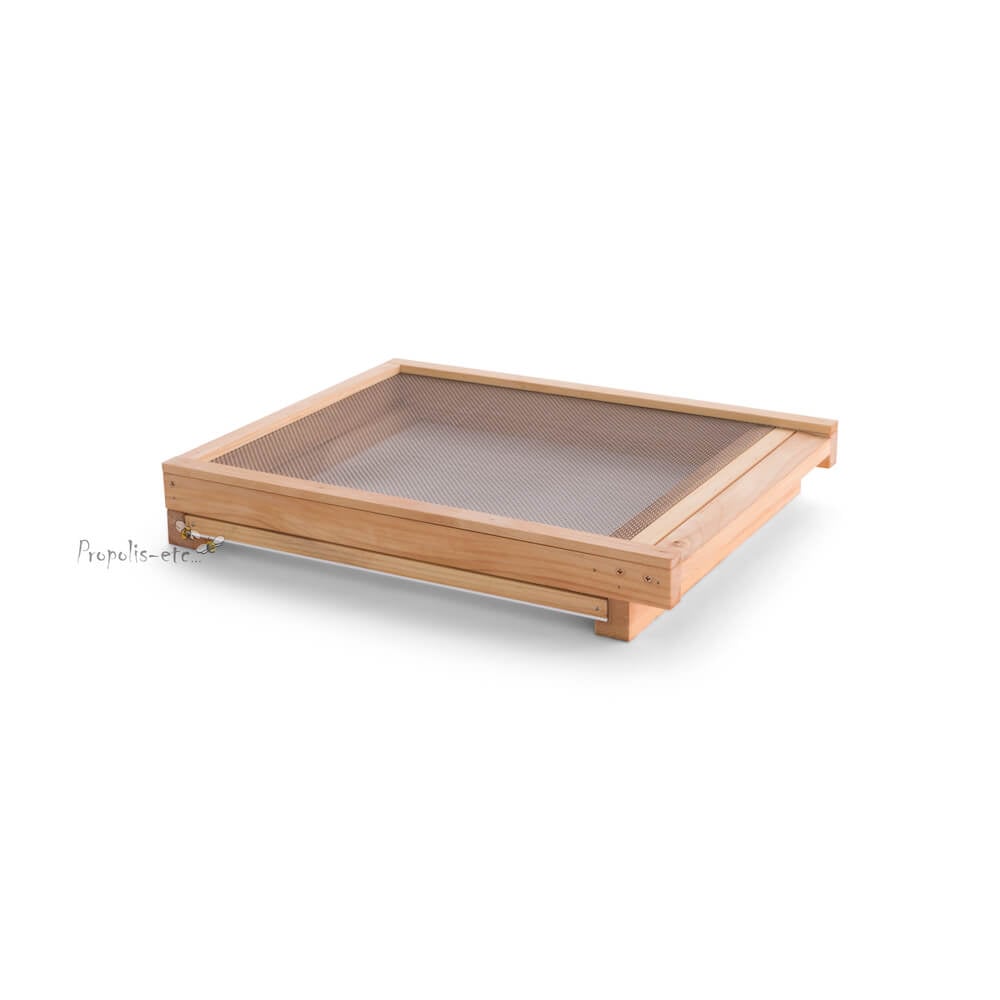
Screened Bottom Board (Side Drawer) - Waxed
The "Apinovar" tray, designed by beekeeper Jean-Pierre Chapleau, facilitates varroa mite management.«application of flash treatments with formic acid. The drawer slides to the side. It also allows for varroa mite detection using the sticky cardboard. The wood is soaked in paraffin for lifelong protection.
Shipping notice We are not responsible for any damage that may occur during the shipping of this product.
Description
A screened bottom board is an excellent choice for a beehive. At any time of the season, monitoring with sticky cards is possible, allowing you to assess the varroa mite infestation level and, most importantly, guiding your choice of treatment to prevent colony collapse. This is the main use of the drawer. Aside from monitoring, the drawer should always be removed and stored. Otherwise, it risks becoming the hive's "garbage dump" and can be a breeding ground for certain parasites, such as wax moths. The exceptions to this rule are as follows:
1) to promote brood development in spring; in this case, the drawer can be put in place for 2 to 3 weeks as soon as the hive starts to become active (usually in April).
2) The hive is in a corridor exposed to strong winds during the cold winter months; the drawer will offer beneficial protection.
The use of sticky cards for varroa mite detection:
Place a sticky card (SB-1150) over the drawer (under the mesh) for 72 hours and count the natural fall of the varroa mites. Divide the number of hours into 24-hour periods, in this case, 3, and then divide the total number of varroa mites by this number. If, for example, you count 36 varroa mites after a 72-hour period, you must divide 36 by 3, which gives a result of 12 varroa mites per 24 hours. Record the results carefully. Treatment thresholds vary depending on the time of year. Normally, treatment is required when there are 3 or more varroa mites per day.
Specifications
| Dimensions (L × W × H) | 56.00 × 42.00 × 8.00 cm |
| Weight | 2.00 kg |


